Once you have completed your Tracing project and published the pages to your site, you need to publish a reflection post as well. The post serves to turn the project in when it syndicates to the class site, and is also an opportunity for you to explain your process in the work you just completed.
Your reflection post should link to the main page for your project and also to the assignment prompt. Tell us in the post what the thesis of your essay is and give a one or two sentence preview of your argument.
You should also address the following questions:
Before writing your essay, you went through a pretty involved process of tracing and annotating two pages from the books. Briefly explain what that process was like for you — probably this was very different from most other writing you’ve done, so try to explain what was useful about the process for you. What productive thoughts or analysis occurred through the act of tracing and annotating?
For this assignment, I asked you to be very conscious of writing an inductive essay with an ABT thesis at the end, which is probably a pretty foreign way to structure an essay for you. How did your writing process change to address this assignment?
This assignment is a close reading exercise focused on identifying aspects of the “secret language of comics,” the series of choices the authors make in crafting comics that probably pass by many readers with little or no conscious notice. Do you feel that this assignment helped you to get in on this secret language? Do you understand Stitches and Fun Home better after having written this project? What’s the single biggest insight you gained about the two books during the process of tracing, annotating, and analyzing these pages (maybe something you “knew” on some level before you started but that you really get now, or maybe something you hadn’t really noticed until you worked on the project)?
Now that you’ve completed your Literacy Narrative Comic, publish a reflective blog post of about 500 words about the writing process, paying special attention to how the work you have done has helped you to meet the Learning Outcomes for this class. That post should link to the page with your literacy comic.
Some other questions you might respond to: How was it different to write your literacy narrative as a comic? How did you think differently once the visual component was added? How did that help you to see the story you were trying to tell in different terms? Was your analytical thinking process any different? How have your thoughts about your alphabetic literacy narrative changed in the process of transforming it into a comic?
I’d also like you to discuss choices you made in creating your comic and to explain why you chose the way you did. Especially if there’s something you were really trying to do in your comic which you felt you couldn’t realize as perfectly as you would if you had a lot more time, more resources, or if you could have hired an illustrator to turn your vision into exactly what you wanted. If there are aspects of your comic where you have a clear sense of what you were trying to accomplish and how you would have done so if some things were different, then explain that in your reflection. Doing so allows you to demonstrate that you have the knowledge you need about this sort of writing even if you have not yet developed all the skills necessary to make that knowledge visible in the final artifact you’ve produced
You should organize the work on your course site into a finished portfolio showing all the work you have done this semester. Make certain that your entire course site looks complete, coherent, and like you’ve given some thought to its overall design and aesthetics. Make sure all the major assignments are available in the menu and that there is also a link in the menu that will take a reader to your sketches and reflection posts.
The reflection essay described below should become the new home (or index) page for your course site and should begin with a note indicating that the site is an archive of the work that you completed as part of ENG101 at Emory University during fall semester 2025. You should link to the course site, so that a reader who is going through your work can easily find out more information about the course you were in.
The writing process is long. We plan, rewrite, revise, and repeat over and over and over again until—at some point—we arrive at a draft. But we know, if given the chance, that even then we could continue to improve our work.
Your final assignment is to pick the project that has meant the most to you from this course and imagine how you would rewrite or revise it if you were given another month. Specifically, you will consider how you would rewrite or revise particular elements of the project so that it would be better attuned to its current rhetorical situation or suited for a new one.
If given another month, would you modify your project’s thesis to make it more specific and further distinguish it from established arguments? Would you devise new strategies to persuade your audience? Would you change how your project responds to outside sources? Would you modify its voice or style? Would you reorganize it? Would you change its genre or mode? Would you rework it to further your own personal, professional, or community interests and commitments? As you begin this assignment, questions like these will provide starting points for thinking about the rhetorical situation of your chosen project and how you might revise/rewrite accordingly.
Instructions
Your essay must be three-to-four double-spaced pages, and it must examine one or twoquotations or multimodal excerpts in depth. The following is a suggested format, but so long as your essay analyzes two instances from your chosen project, it can be successful.
Introduce the project you’ve selected to your audience, which, for the purposes of this assignment, you can imagine as a professor familiar with rhetoric and writing but unfamiliar with your selected project. In an efficient paragraph or two, tell your audience what they need to know to understand the project and the aspect of its rhetorical situation that you would address in your hypothetical revision.
The aspect of the rhetorical situation you pick can be one that the assignment entails—for example, the rhetorical situation of the academic essay typically entails a thesis. Or it can be a new one that you would choose to pursue in your hypothetical revision/rewrite—for example, transforming an academic essay into a podcast would require new considerations of audience.
Pick a paragraph or two (or equivalent multimodal excerpts) from your project that you think exhibits a particular strength or area for growth regarding how you addressed a rhetorical situation. For example, you might choose an excerpt that you feel effectively addresses (or fails to address) your target audience or that demonstrates a style well (or poorly) suited to your intentions.
Referencing specific details from the paragraph or two you selected, explain how over the next month you would revise or rewrite to further develop the identified strength or to address the area for growth. This section might be three-to-five paragraphs long. It should include multiple quotations or a block quotation from your selected project as you describe how you would approach your hypothetical revision.
Feel free to quote from your peers or instructor here if their responses would guide your revision. But keep in mind, this is not a time to merely repeat your instructor’s feedback—though the perfection quotation may be useful. Emphasize what you think about your own writing. For example, if you reworked this project for a context outside of first-year writing, what strategies would you use to respond to a new rhetorical situation and address your target audience?
End with a brief paragraph describing the specific challenges that would come with implementing your hypothetical revisions and how you would meet those challenges.
Some Tips
Avoid clichés, especially I learned so much and I was ignorant before but now I see clearly. This assignment is about your original ideas for revision.
Don’t tell me what you think I want to hear. Be honest and direct in your reflections.
Write with lively and engaging prose.
Remember: The more deeply you reflect on your work, the better your craft will become.
A pecha kucha is a particular style of oral and visual presentation where speakers present while showing 20 slides, each one timed to display for exactly 20 seconds. Hence, every pecha kucha presentation lasts for 6 minutes, 40 seconds.
Here’s a sample pecha kucha, which I chose almost at random from the pecha kucha site, called “Drawing to Document,” by Charis Loke:
For your third major project this semester, you’ll perform something akin to a pecha kucha, but in order to keep the scope of the assignment manageable and to have enough time for you to give your presentations to the class, we’re cutting the number of slides you’ll have in half — so you’ll have exactly 200 seconds, with 10 accompanying images, to present your argument.
The ordinary response to atrocities is to banish them from consciousness. Certain violations of the social compact are too terrible to utter aloud: this is the meaning of the word unspeakable.
Atrocities, however, refuse to be buried. Equally as powerful as the desire to deny atrocities is the conviction that denial does not work. Folk wisdom is filled with ghosts who refuse to rest in their graves until their stories are told. Murder will out. Remembering and telling the truth about terrible events are prerequisites both for the restoration of the social order and for the healing of individual victims.
The conflict between the will to deny horrible events and the will to proclaim them aloud is the central dialectic of psychological trauma. People who have survived atrocities often tell their stories in a highly emotional, contradictory, and fragmented manner that undermines their credibility and thereby serves the twin imperatives of truth-telling and secrecy. When the truth is finally recognized, survivors can begin their recovery. But far too often secrecy prevails, and the story of the traumatic event surfaces not as a verbal narrative but as a symptom.
The psychological distress symptoms of traumatized people simultaneously call attention to the existence of an unspeakable secret and deflect attention from it. This is most apparent in the way traumatized people alternate between feeling numb and reliving the event. The dialectic of trauma gives rise to complicated, sometimes uncanny alterations of consciousness, which George Orwell, one of the committed truth-tellers of our century, called “doublethink,” and which mental health professionals, searching for calm, precise language, call “dissociation.” It results in protean, dramatic, and often bizarre symptoms
And here’s another quote from the same book:
Recovery unfolds in three stages. The central task of the first stage is the establishment of safety. The central task of the second stage is remembrance and mourning. The central focus of the third stage is reconnection with ordinary life.
Assignment Fundamentals
Due: In class presentations on 11/27 and 11/29. (We’ll spend the first 45 minutes of each class on presentations. Please be sure to attend class on these days and be a good, attentive, respectful audience for your peers.)
Medium: This presentation will take the form of a “halfa kucha,” which means that you will create ten slides that will each stay on the screen for 20 seconds before automatically progressing to the next slide. Each slide should have a compelling visual image on it with no or very minimal text. Over the three minutes and twenty seconds of the slideshow you will explain your argument orally to the class. I will ask you afterwards to export the slideshow as a video or PDF to publish to your site along with a description of your argument.
Audience: The audience is your classmates, so they have read and thought about and discussed the books — you should not waste time summarizing the plot or giving basic background information that we’ve already discussed in class. But just like with other assignments this semester, assume that you are the smartest, most perceptive reader in the class and you have noticed things the rest of the class has not.
Tone: You can choose a tone ranging from casual to “academic casual” to very formal. Whatever fits your argument, personality, and presentation style the best. Remember, though, that you’re talking about trauma — so if you decide to be casual, still be respectful to the subject and to the sensibilities of your audience.
Title: You are required to have a really good, interesting title for your presentation.
Prompt
Thinking about the two quotes from Herman above and Hillary Chute’s “Introduction: Women, Comics, and the Risk of Representation” that we read earlier this semester, present to the class an argument about how two or three of the books we have read this semester investigate and represent trauma and healing.
Reflection Prompt
Once you have completed your presentation, I’ll ask you to either send me the slides or ask you to host them on your sites — the latter is preferable but might be too much of a pain with the WordPress.com sites you’ve got. Then you’ll write a reflection post and link to your presentation wherever it lives.
it provides a compelling preview of your narrative that summarizes your controlling idea in a sentence or two;
it reflects on what you have learned in the process of writing your literacy narrative;
when your post syndicates to the class site, that constitutes turning in your narrative.
Some questions to consider in your reflection:
What was your writing process for this narrative like? Did it feel strange for you to do the freewriting exercises first? How did the freewriting influence the essay you eventually wrote?
What did you learn about yourself by the end of writing your narrative? Was there anything that you found surprising, or something about yourself that you came to view differently in the process of writing this essay?
What sentence from your essay do you think someone else reading it would identify as the most interesting sentence? Why?
Uploading and publishing to your new WordPress site
Visual images as representations of complex conceptual topics
Avatar
Once you’ve created your web site, you need an image to represent yourself and/or your site for the class: an avatar. Your avatar can be whatever you want it be but try to create something that both reflects your personality and speaks to the topic for this class in some way.
Start by choosing one or more of your own photos as the basis of the avatar, drawing something yourself and scanning it, or finding one or more Creative Commons-licensed images on Flickr that you can modify. (Make certain to keep a note for yourself of the URL for the photos you use if they are not your own.)
CC-licensed images
Creative Commons licenses work with copyright law so that creators can share their work in a way that allows others to use it with attribution. The video on the left gives a good overview of the concept of Creative Commons licensing. The one on the right gives more explanation of how they work. They are short and worth watching.
Crop and otherwise edit the photo(s) in a photo editing application (like Photoshop or Pixlr). You can create a layered or collage effect, if you’d like. Add your name on your badge in such a way that it’s legible — it can be your full name, just your first name, or the nickname you want to be called this semester.
Your final badge should be square and at least 512 pixels wide and high. Please make certain your badge is square so that it will fit into the design on the student sites page.
Publish
When you’re done, you’ll need to put the image two places, with an optional third:
First
Load the badge into your Media Library and publish it to your site in a blog post. (If adding it as a feature image means that the entire square image won’t display, then also insert the image into the post itself.)
Include information and links in the post about the source(s) for images included in your badge.
Write a paragraph or two about why you chose those images, what aspects of yourself and your interests are represented in your badge, and/or what difficulties you faced in creating the badge.
Please tag your post with the tag “sk1,” plus any additional tags that you think are appropriate.
Second
Go into your dashboard to Settings > General and select “Change Site Icon.” Load the image as your site icon.
Finally
If you do not already have a gravatar, create a gravatar account and load your avatar there. From then on, your avatar will show up as your picture when you leave comments here and on other students’ sites.
For your sketch assignment this week, I want you to create a set of visual notes for one day in one class (other than this one) that you are currently enrolled in. You do not need to take your visual notes in real time; in fact, I recommend that you don’t. I recommend that you go to your classes and take notes in whatever manner you normally do, then after class go through your notes and recreate them as visual notes.
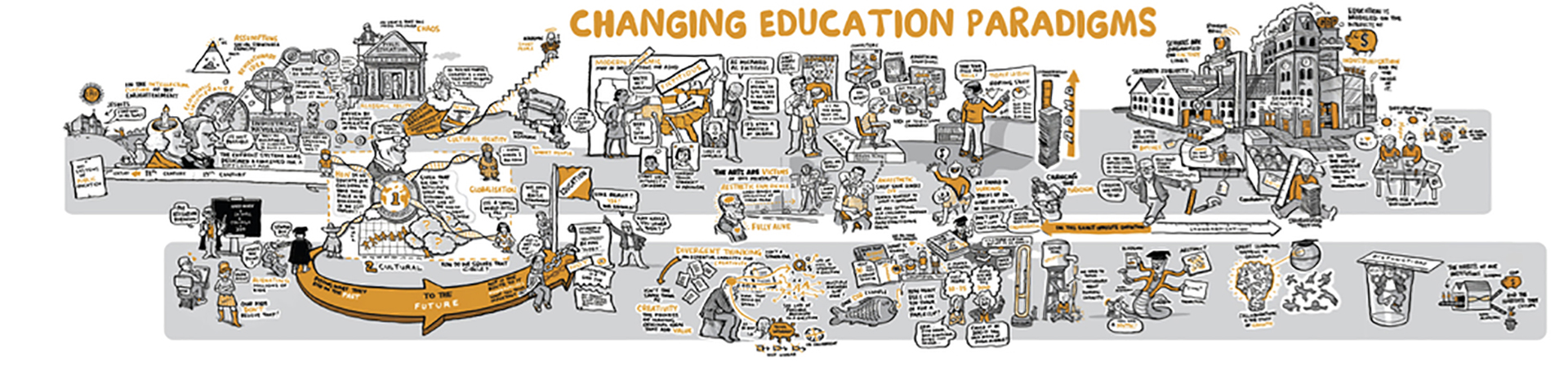
Below is an example of a professional illustrator creating a set of animated video notes to represent a lecture by Sir Ken Robinson on “Changing Education Paradigms”
You do not need to make a video like this, but only a static image.
You do not need to draw your notes in a digital environment, either, though you are certainly free to do so. If you prefer to doodle with pen, pencil, or marker on paper then do that and once you’re done with your drawing, just scan the pages as JPG files so you can upload them to your site. If you have an iPad or other tablet or would like to draw on your laptop or desktop, then you might try apps like GoodNotes, Procreate, Inkflow, or Adobe’s Sketchbook or search for other free/cheap drawing applications. I am completely tool agnostic on this assignment, so make your drawings in whatever manner make sense to you.
Your visual notes do not need to be polished or beautiful or supremely intricate, like the RSA Animate video above. Do try to take this assignment as an opportunity to really engage differently with your material – don’t just make a series of doodles that follow the outline of the lecture or discussion in your notes but try to translate the concepts and information into a new, visual set of notes. You might think about creating flowcharts or diagrams, which are also visual devices.
Once you’ve got your notes, load them onto your course site as a sketch post. Embed the images from your notes into the post and as you do, take a few moments to reflect on the process and then write a paragraph or two about what you learned during the process of creating your visual notes. Did it help you to understand the course content any differently or better to create notes visually rather than just as text? Did you discover anything new about yourself or the way you think in the process? Did you find it enjoyable or find some aspect of it particularly interesting? Someplace in your reflective text, create a link back to this blog post assignment.
Stephen Mcmennamy is an Atlanta artist and Creative Director who was at the advertising firm BBDO. He first came to my attention when I saw his series of “combophotos” that splice together two different images to form a surreal new creation.
Here are a few examples from him:
cauliflower + poodle
paintbrush + spaghetti
bridge + guitar
Take a few moments to look through the images he’s posted on his site linked above or on his Tumblr or his Instagram. Notice that each of these is just two rectangular images set next to each other to create a single square image. There’s no need to copy & paste or layer anything in Photoshop — simply crop two images and set them alongside each other to create a new image.
Then create your own square combophoto and publish it to your site. You can take your own photos, but probably you’ll want to use Creative Commons-licensed images you find on Flickr or Google images — make sure you give credit to the originals that you modify to create your combophoto.
The level of technical aptitude for this assignment is actually relatively small, just simple cropping and resizing. The greater part of the challenge is thinking creatively and finding images that you can work with. That said, note that Mcmennamy comes up with ideas and then specifically stages photos to combine, and he seems to often spend significant amounts of time shooting and selecting his images. You won’t have lots of time, models you can hire, or expensive photo equipment to work with, so I don’t necessarily expect your final images to be as polished and perfectly aligned as his are. More important is for you to be playful and come up with images that combine to create something funny or witty or striking.
To edit the two photos together, you can use whatever photo editing software you’d like. Pixlr is a good free web app, as is PicMonkey. Adobe Photoshop is also available for you to use on the computers in the Media Library on the 4th floor of the Woodruff Library.
Once you have your image, publish it in a post on your class site. Don’t forget to give it a funny or witty title! Tag your post “sk4“
Write a paragraph about how you went about choosing the two images you combined and why. What challenges did you face as you created your combophoto? What do you think your final image conveys?
This is a pre-writing exercise that is designed to help you prepare to complete your first quest, writing the literacy narrative. I’ve adapted this exercise from the Lynda Barry’s “x-page” warmup exercise in the book Syllabus. It should take you 45 minutes to an hour to complete this exercise.
I’m going to describe the steps in text below and I will also include an audio recording of me reading these instructions out loud and pausing for you to write in response. You might find it helpful to play the audio and simply write in a notebook or type on your laptop as you listen instead of having to come back and read text as we go — if nothing else, it might stop you from spending longer on the steps than you need to, so I suggest you try it. If the audio is not helpful for you, for any reason, then you can read the same instructions below.
Audio Prompt for this assignment
Ten Memories
Think back over the course of your life so far and make a list of ten memories that you associate with reading and/or writing. Just take about 3 minutes and make a numbered list of ten memories that come to mind.
Pick One
Then, read over your list and pick the one memory that seems the most vivid to you. Circle it. Then on a new page, write that memory at the top of the page as if it were the title of a story and draw a big X across the page. (If you’re typing on a laptop, the big X is optional)
Twenty Questions
Picture yourself in the memory that you are exploring and then write the answers to the following questions anywhere on the page. Pretend we are having a conversation, so you can see the image but I can’t so I’m going to be asking you these questions to help me “see” the image too. Keep writing until the next question is asked — no detail is too small or unimportant.
Where are you?
What time of day or night does it seem to be?
What season does it seem to be?
Where is the light coming from?
What kind of light is it?
What’s the temperature like?
What does the air smell like?
What are you doing?
Is there anyone else in that place with you?
What are they doing?
Why are you there?
What are some of the sounds you can hear?
What are some of the things you can see?
What’s directly in front of you?
If you turn your head to your right, what’s there?
If you turn your head to the left, what do you see?
What is behind you?
What’s below you and around your feet?
What’s above your head?
What emotions are you feeling in this space?
Once you have jotted answers to those 20 questions on your x-page turn to a new page and freewrite for 10 minutes about that memory. There are no wrong or right things to write about or ways to write about the memory. Just start by elaborating further about any of the details you jotted down on the x-page and then keep writing without stopping about whatever thoughts are coming to your head about that memory. Try not to censor yourself or worry about the quality of what you’re writing. At this stage, all you are doing is generating ideas — you will think about structure and wording later.
Now look back at your original list of ten memories. Are there any other memories that you’d really like to explore further? You don’t need to repeat the entire process described above for the memory (though you can, if it seems like it would be useful) but do jot down some thoughts about any of the other memories on your list that seem worth thinking more about right now.
Building from Memories, Asking Questions
Now that you’ve taken the time to write about one or more of those memories, pause to consider the following questions about your history with reading and writing. They may or may not directly connect with the freewriting you just completed. Jot down brief responses to these questions:
How did you feel about reading and writing as an adolescent — say, during middle and high school? What sorts of experiences did you have as a reader and writing in school?
What are your experiences with social networking sites like blogs, Facebook, Twitter, or others? What do you remember about your first experiences with such sites? Do you text on a smartphone? What sorts of experiences have you had writing to/for people with those sorts of technologies?
What are some of the biggest struggles you have had as a reader and/or writer?
Christoph Niemann is an illustrator, artist, and author whose work regularly appears in the New York Times, the New Yorker, and elsewhere. He’s got a mixed media series that he calls “Sunday Sketches,” in which he takes some object from his surroundings and creates a sketch on the page around it. Some of the best such works he’s included in his book entitled Sunday Sketching.
Some examples from Niemann’s Tumblr:
You can see that each of these pieces is an actual three-dimensional tangible object placed into a drawing on paper to transform that object into something new. Niemann then photographs the resulting sketch to create a two-dimensional artifact.
For your third sketch assignment, I want you to create your own Sunday sketch in a similar style.
Take a picture of your sketch and publish it as a post.
Give your post a funny or witty title.
Write a paragraph or two in which you explain the process whereby you came up with the idea for your Sunday sketch and the choices you made in realizing that idea as an actual sketch.
Include a link back to this prompt and tag it “sk2”