Open post

Two Paradigms of Healing

Here are two fundamental paradigms of healing that might be helpful for you as we move through our discussions over the rest of the semester.

Trauma and Healing

The first comes from Judith Lewis Herman, Professor of Psychiatry at Harvard Medical School, Director of Training at the Victims of Violence Program in the Department of Psychiatry at the Cambridge Health Alliance in Cambridge, Massachusetts, and a founding member of the Women’s Mental Health Collective. She has done extensive work with war veterans and victims of child abuse and incest in developing her framework. In Herman’s book Trauma and Healing she outlines a three-stage process of healing:

Recovery unfolds in three stages. The central task of the first stage is the establishment of safety. The central task of the second stage is remembrance and mourning. The central focus of the third stage is reconnection with ordinary life.

So three stages:

  • Safety
  • Truth
  • Community

In her subsequent book Truth and Repair: How Trauma Survivors Envision Justice, she adds a fourth stage:

  • Justice

Trauma-Informed Care

The second paradigm is not drawn from a specific researcher nor is it a framework for treating specific individuals who have experienced trauma. Instead, it’s a method of approaching interactions with people that recognizes that many people have experienced trauma in their lives, it’s not always apparent who has or what kind of trauma they are carrying. Trauma-Informed Care is a more generalized way of delivering care that integrates knowledge about trauma into policies, practices, and procedures, with the aim of creating environments that are safe, supportive, and empowering for everyone.

There are six principles of Trauma-Informed Care:

  • Safety: Ensuring physical and emotional safety for everyone involved.
  • Trustworthiness and transparency: Building trust through clear communication and consistency.
  • Peer support: Encouraging shared experiences to build community and support.
  • Collaboration and mutuality: Emphasizing partnership and minimizing power dynamics by sharing decision-making and responsibility.
  • Empowerment and choice: Prioritizing individual strengths and offering choices in decision-making processes to encourage active participation in achieving one’s own goals.
  • Cultural, historical, and gender awareness: Acknowledging and addressing the cultural and societal contexts that influence a person’s experience of trauma.

These are paradigms from caring disciplines, not frameworks for understanding texts; however, do they help you to notice patterns withing the texts we are reading, which are all representations of trauma and recovery? Do these two paradigms bring up questions for you about the texts we are reading?

Open post

It’s Crowded at the Centre of the Earth

I taught It’s Lonely at the Centre of the Earth in fall 2024 too. Just as we wrapped up our discussions, it occurred to me to check Thorogood’s social media to see what she had been working on recently, when I saw this heartbreaking post of hers:

Open post

Clarity

As you work on transforming your literacy narratives into comics, I’d recommend that you keep in mind Scott McCloud’s Making Comics, in particular the Clarity diagram:


You will need to make choices about moment, frame, image, word, and flow as you draw your comics. You can experiment in order to develop the style that seems appropriate to the story and ideas that you are presenting — your goal is to create a clear narrative that makes your argument in a way that your readers can grasp. That will probably entail playing with techniques that are new to you.

Open post

Comics puts productive pressure on what “normal reading” is

“Comics puts productive pressure on what ‘normal reading’ is — not because it is so easy, or immediate, but rather because paths of reading and different moments of time can compete as alternatives.” – Hillary Chute

Some key terms from Hillary Chute’s “Comics for Grown-Ups”:

  • “Narrative drawing” or “picture writing” (instead of illustrative)
  • Decode (vs. read)
  • Gutter
  • “Secret language of comics”
  • Spatially site-specific
  • Weirdness of time
  • All-at-onceness (or symphonic effect)
  • Directions of reading
  • Slowness
  • Hybridity
  • Graphic medicine

The page from Hergé’s Crab with the Golden Claws that Chute discusses on pp 24-25:


Open post

Week Ahead: 5

5 9/23
  • Stitches — “A few years ago I had the following dream. In the dream I was a boy of six again” (274-329)
  • Hillary Chute, “Comics for Grown-Ups” from Why Comics?: From Underground to Everywhere
Sketch 4: Combophoto
9/25

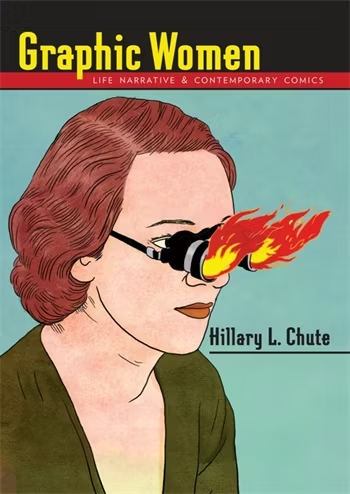
For Tuesday, you have a short chunk of Stitches to read. We’ll spend a lot of class on Tuesday discussing Hillary Chute’s chapter “Comics for Grown-Ups.” Chute is probably the foremost academic authority on comics these days — she’s the Distinguished Professor of English and Art + Design at Northeastern University in Boston and has published many books of criticism on comics as a medium.

The first twenty pages of her article provide a very useful overview of the history of comics with lots of useful information in it. But in class on Tuesday, we’ll focus most of our attention on the last 10 pages of the essay, the section called “Reading Comics,” which provides us key terms and a theoretical framework for understanding how comics works and how to read and analyze them.

On Thursday, we’ll focus on the beginning of Spinning, starting off that discussion by comparing Walden’s graphic narrative to David Small and to Allie Brosh.

Tillie Walden won the very prestigious Eisner Award for Spinning when it was published in 2018, when she was 22 years old. Spinning, which again was published when she was 22 years old, was Walden’s fourth graphic narrative book. In the five years since Spinning was published she has published eight more books (to be totally fair, two of those are forthcoming later this year). You can read all of her fifth book, On a Sunbeam online here — it’s worth at least glancing through some of those pages to get a sense of where her style has gone since Spinning.

We’ll start with how Walden establishes character and setting compared to Small and how her tone/visual style is similar and different to Small’s. How does Walden use the page, panels, and gutters in comparison to Small? Note that there is one small moment in Spinning where Walden shows herself holding a copy of Stitches, so she has signaled for us that Small’s text is an influence for her — how has it influenced her as a writer?

Open post

Week ahead: 4

4 9/16
  • Stitches — rest of “I was six” and “I was eleven” (64-156)

Two Tribes Book Talk by Emily Bowen Cohen. 4pm @ Jones Room (Level 3) of the Woodruff Library

Sketch 3: Visual Note Taking
9/18
  • Stitches — “I was fourteen” & “I was fifteen” (157-273)

Emily Bowen Cohen is an award-winning author and engaging public speaker known for powerful storytelling that explores complex identities. She is Jewish and a member of the Muscogee (Creek) Nation, and she creates comics that explore cultural intersectionality. She will be visiting Emory on Tuesday afternoon to talk about her new book, Two Tribes: Real Life Stories of a Jewish Native American, on Tuesday afternoon at 4pm in the Jones Room on the 3rd floor of Woodruff Library.

I strongly recommend that you attend her talk if at all possible. If you attend and then write a reflection post on your site then I will give you extra credit towards your final grade. Describe the event briefly and write about connections you observe between her talk and the discussions we’ve been having as a class or whatever parts of Cohen’s talk you find especially interesting.

We’ll focus our discussions during week four on working through Stitches, following Small’s life from ages 6 to 15. Pay attention to the way pages are laid out and to what you are expecting as you read versus moments where you are surprised.

Open post

Deductive -> Inductive Writing

We’ll spend some time in class today looking at the essay below as a method for breaking down differences between inductive and deductive writing and to see a more concrete example of an ABT thesis.

A number of years ago, I assigned students in a class three hard-boiled detective short stories and asked them to write a comparative essay in response. I no longer remember the exact prompt I gave those students, but they needed to compare the stories. The three stories are all set in Los Angeles: The Big Sleep is one of the originators of the genre, with a white male hardboiled detective in the 1930s; in “Murder is My Business” the protagonist is a lesbian detective in LA of the 1980s; and in Devil in a Blue Dress the protagonist detective is a black man in LA of the 1950s.

Below is a real essay a student wrote in response, which has some good observation in it but the five paragraph structure of the essay seriously undermines the author’s ability to make any kind of argument. Please read over the essay (it shouldn’t take more than 5 or 10 minutes) then we’ll spend about half the class looking at this example and go through a process of revising the structure of this essay to be an inductive essay using an ABT thesis.

Here is the essay.

Posts navigation

1 2
Scroll to top