For this sketch assignment, I used a cell model as my assemblies to represent what I’ve done throughout this course. Each part of the cell represents something I’ve accomplished over the three months I’ve been in this course, including different assignments and writing skills I’ve learned.
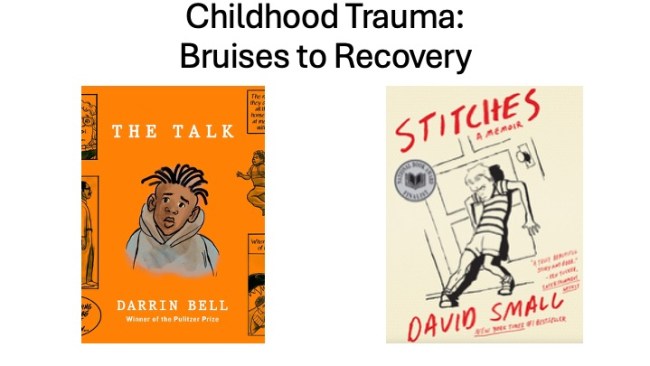
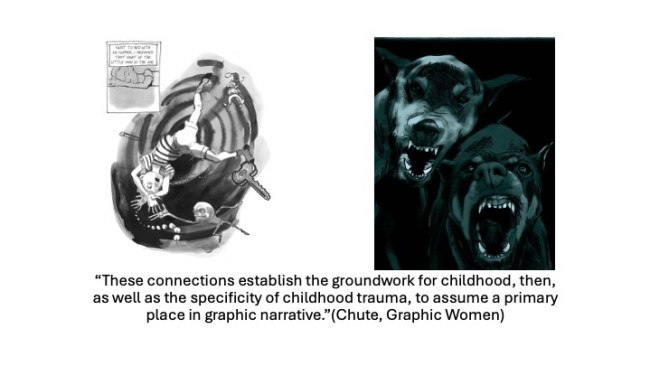
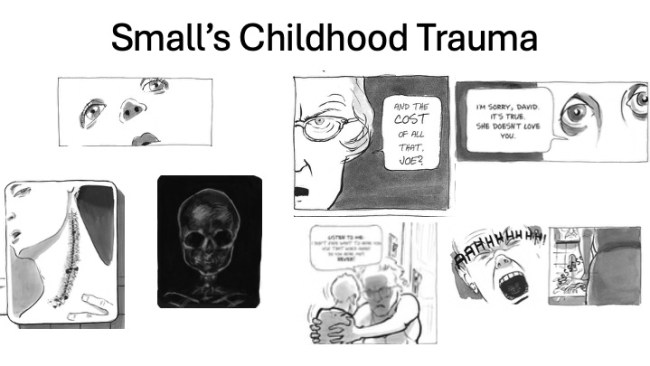
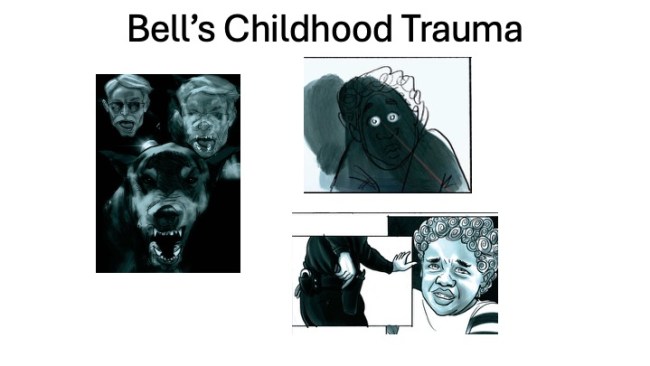
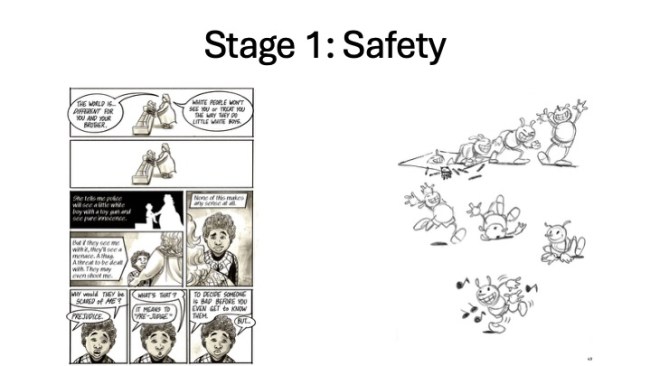
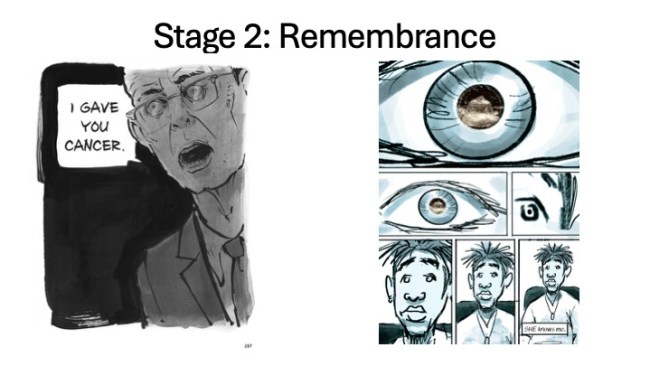
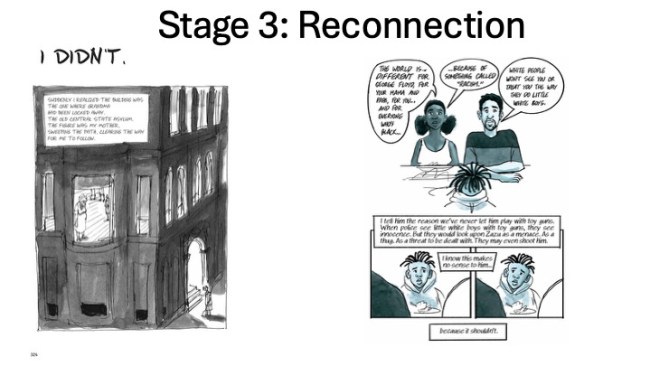
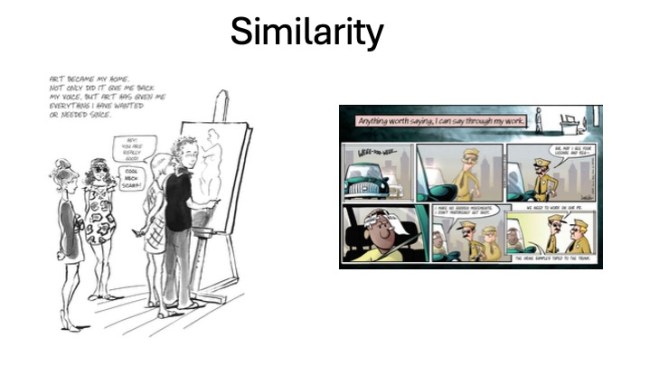
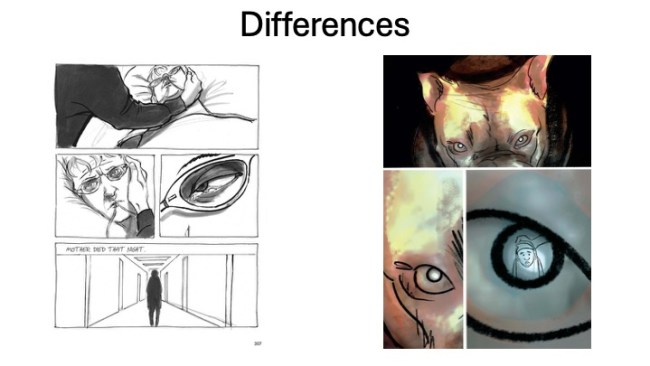
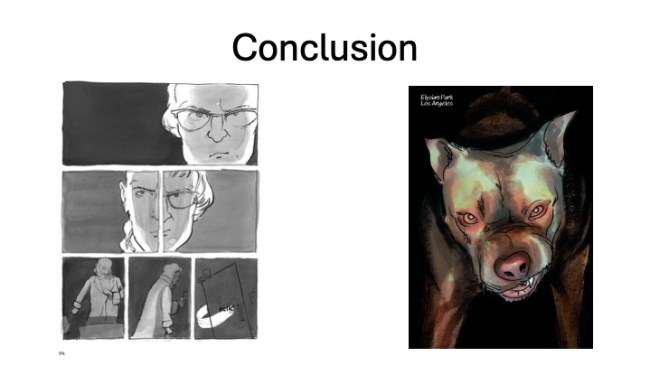
When I first started the Halfa Kucha assignment, I felt it was really hard to fit all my arguments into a 3-minute-and-20-second presentation. I began by writing my topic in a Word document, focusing on childhood trauma in The Talk and Stitches. I then crafted my main arguments and tried to support my thesis with evidence. However, I realized it was extremely difficult for me to cut content because I felt that if I didn’t include every point from my draft, my argument wouldn’t make sense. In the end, I did it—I removed the parts that I thought wouldn’t affect the overall presentation. To help my audience follow my argument more clearly, I often compared the two comics side by side by placing one image from each comic on the same slide to represent the evidence for my claims. Visually, this allowed my audience to see the comparison directly. What I learned from this presentation is that a script isn’t necessary if I truly understand what I’m going to say. In high school, I often relied on scripts and note cards, but with strict time limits for each slide, it’s better to let go of the script so you can present more naturally and confidently. I also realized that many of my classmates noticed strong arguments that I missed during my first reading, which makes me want to read graphic memoirs and novels more carefully in the future.
https://open.spotify.com/embed/playlist/3EM7SZZ6B5ZepboBKMUsfw?utm_source=generator
The overall theme and rhetorical situation I’m trying to establish in this playlist is love. Each song is about love, whether it’s a bittersweet kind of love or a love that’s pursued but never attained. There’s also a variety of musical styles in my playlist, including art rock, dream pop, and pop. This is the kind of playlist I would listen to when I’m alone and just chilling. I feel like the process of creating this playlist showed me how powerful and beautiful music can be when it’s actually telling a story.
I recreated the famous “What’s in the box?” scene from the movie “Se7en” or “Seven”. This is the scene when David Mills discovered what is in this mysterious box. I don’t want to spoil the movie, but when I first noticed that what is actually in the box, I was completely shocked. This movie gave me the sense that the justice side will not always win. I used a plastic pipe for the gun, and I invited my friend to be detective William. This one of the best movies that I’ve watched, and I really recommend it to those who are into crime movies.
https://mikebest.me/blog/looking-back-the-cinematography-of-seven
My trilogy of literacy narrative projects has helped me understand my purpose for reading and has also led me to discover new ways of reading. I’ve learned that words are not the only way to understand a piece of literature; the combination of words and images can be an extremely powerful way to receive the author’s main ideas and messages.
I feel like my first literacy narrative focused on how to turn words into images so that I could better understand the text. But after completing my comic and reading so many graphic memoirs and novels, I began to focus more on the interaction between words and pictures, and how we, as writers, can use that combination to communicate our message to readers.
Now I see that the story I’m trying to tell is not just “comics helped me learn to read,” but something bigger: I’m really arguing that different forms of literacy should be valued equally, especially for people like me who don’t fit the traditional idea of a “good reader.” Before, I focused mainly on the events in my life—hating “pure reading,” discovering Diary of a Wimpy Kid and manga, and taking ENGRD 101. After making the comic and then returning to the essay, I started to see my story more as a critique of the idea that only long, text-only books count as “serious” or “real” literature.
Panels, Pages, and a New Way to Read
Conceptual Issue/Question tracked I tracked my daily sleep from Oct 29 to Nov 8 to see which events made me sleep more or less than usual. The pattern is clear: I sleep less on Mondays and Wednesdays and more on the weekend. This lines up with my course schedule—ENG 101, HIST 100, and ANT 190 are stacked on Tuesdays and Thursdays—so I compress heavy reading into Monday and Wednesday nights and stay up late to meet deadlines. Morning classes on those same days remove any chance to recover. The result is a deadline-driven cycle of short sleep followed by weekend rebound, which can hurt attention, memory, mood, and long-term health.
Reflection To change this, I’ll spread readings earlier across Friday–Sunday, set an 11:30 p.m. cutoff on school nights, and add Sunday and Tuesday “buffer blocks” for spillover work. I’ll keep wake time consistent within ±30 minutes to stabilize my sleep drive, and I’ll track contributors alongside hours slept—caffeine, evening screen time, late meals, and major deadlines. If I repeat the sketch over four weeks and annotate big assignments, I can test which factors most strongly predict short nights and adjust my schedule with evidence rather than guesswork.
This comic is a visual autobiography of how I moved from resisting reading to inhabiting it. It demonstrates the core idea from my essay—confusion, curiosity, method, and understanding—into three pages of images that my earlier self would have understood better than any paragraph: a story told in scenes rather than abstractions.
Page 1 frames reading as burden. I could analyze the film but not the book because I had been “seeing” only pictures, not prose. I drew out two of my favorite films, which is Fight Club and Star Wars. The Gollum panel (with the word “READ” in harsh red) personifies the fear that reading would expose my weakness. In my essay I ask, “Why was this?”—the page answers by staging the mismatch between how I processed movies (visually, sequentially, effortlessly) and how I met books (as static walls of text). Page 1 is, therefore, not just failure; it’s a diagnosis.
Page 2 marks the pivot from overwhelm to invention. The rocket and the oversized The Martian book show the first time I let a novel run as a movie in my mind. That choice mirrors the essay’s moment: “I imagined I was on Mars, cultivating potatoes.” The following panel translates process into practice: the pencil and the three margin questions—what is being said, how is it being said, why does it matter—materialize my teacher’s advice and my new discipline. Here the comic turns metacognitive: I’m not only reading a story; I’m reading the way the story works. The final panel on this page, where I face the Gollum with a pen, visualizes that I have learned using a pencil to write down things I both understand and not understand from a reading. In the essay, those verbs replaced summary; in the comic, they become action.
Page 3 resolves the tension by showing that how I could now read the novel (which is The Hobbit) even I have no understanding before. I drew out Gandalf and one of the hobbit to show that now I could actually visualize the book, for both the plot and the characters.
Visual carry the argument: caves versus open air, red threat versus warm greens, solitary struggle versus shared presence. Process is iconized—a pencil becomes a strategy; marginal questions become speech bubbles; rhetorical “moves” become choreography. Most importantly, the comic proves the thesis of my essay: reading power emerges when I slow down, ask better questions, and let language become visible. I did not become a “natural” reader; I became a deliberate one.
I draw about a fun memory of me sneaking to play video games when my parents thought I was asleep but I was actually not. I found out it to be more changeable to draw a Quadriptych comparing to a Triptych, since one more panel could change a lot of stuff and it gives more space for imaginations. But still, four panels are still a limitation as I was planning on this drawing, because the more panels you could draw, the more ideas you could put in and to show a more detailed informations for your audiences.
Tracing these two pages was a fun process for me. I’ve never had an assignment that required me to both draw and write for an analysis, but the tracing-pages task gave me that chance. Drawing the pages first—rather than just taking screenshots and writing—made me think more comprehensively. It almost worked as planning: I could see the details for myself not only by looking at the page, but also by re-creating it.
I did something similar for a few essays in high school, but it was sometimes hard to follow consistently. Writing with an ABT thesis at the end actually makes my essay more engaging than simply comparing the pages paragraph by paragraph. I wrote my thesis first and then drafted the introduction, because I believe doing so makes the essay more fluent and easier to understand.
By tracing these two pages, I noticed details I had missed before. In Spinning, I hadn’t realized how the scene of Tillie sitting on the floor uses a camera-like language: the pair of skates emphasizes her detachment. She isn’t understood by her friends or even by her family. The whole page shows Tillie’s inner state—both detached and disconnected.
Invisible Wounds
Tracing these two pages was a fun process for me. I’ve never had an assignment that required me to both draw and write for an analysis, but the tracing-pages task gave me that chance. Drawing the pages first—rather than just taking screenshots and writing—made me think more comprehensively. It almost worked as planning: I could see the details for myself not only by looking at the page, but also by re-creating it.
I did something similar for a few essays in high school, but it was sometimes hard to follow consistently. Writing with an ABT thesis at the end actually makes my essay more engaging than simply comparing the pages paragraph by paragraph. I wrote my thesis first and then drafted the introduction, because I believe doing so makes the essay more fluent and easier to understand.
By tracing these two pages, I noticed details I had missed before. In Spinning, I hadn’t realized how the scene of Tillie sitting on the floor uses a camera-like language: the pair of skates emphasizes her detachment. She isn’t understood by her friends or even by her family. The whole page shows Tillie’s inner state—both detached and disconnected.
Invisible Wounds