My bag contains all the stuff I could possibly need throughout each day. I have my custom Emory-engraved Owala bottle, which has a capacity of 1.3L of water. This keeps me hydrated. I carry a pencil pouch with a few pens, a Kuru Toga mechanical pencil, and highlighters with which I can add a touch of color to my notes. I also like to carry a few high-protein snacks such as Quest chips, protein shakes, and a few Slim Jims. Atlanta weather can be unpredictable, so I like to have an umbrella on me at all times. I also have my prescription sunglasses, which have my eye power in them. These are really cool as I can magnetically snap on the blue shades or the grey ones depending on what I am wearing. I also like to keep a mini diary and my Sony XM5 headphones on me; they have the best noise canceling I have seen in a pair of wireless headphones. Lastly, I carry my laptop, a high-capacity 25,000 mAh power bank with its cable, and a copy of my passport and F-1 visa (which I am required to have on me at all times by law).
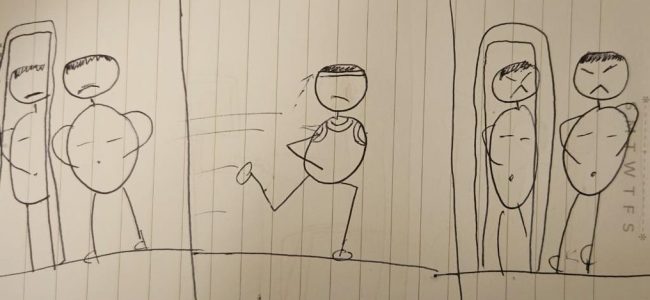
When I began the assignment, I struggled to imagine how to tell a complete story in only three panels. Eventually, I realized I could capture the mindset of people who expect instant results — something I once related to deeply. My comic shows a man frustrated that a brief effort didn’t immediately transform his body. This mirrors how I used to feel when I was far more overweight and impatient for visible change.I have now learnt that real progress comes from consistency , over a long period of time.
Assignment Prompt link / Response link
Thesis: Tillie’s quiet stillness and reflective observation and David’s forced silence and confrontation both reveal the power of visual and textual interplay, but while one chooses silence and the other experiences it, this difference highlights how silence can be both self-imposed and enforced; therefore, Walden and Small use the graphic medium to transform repression into something visible and human.
Preview: My essay compares how Tillie Walden and David Small use visual storytelling to show repression and silence between children and parents. Through color, gesture, and stillness, both authors make readers “stitch together” emotional meaning and see how fear and control shape communication.
Reflection:
Tracing and annotating the pages from Spinning and Stitches helped me slow down and notice the body language expressed in scenes with little to no dialogue. Redrawing each panel made me pay attention to how color, gesture, and space communicate feelings that words can’t always express. Writing the essay, with the thesis at the end, allowed my ideas to form naturally through close observation. This process helped me appreciate the subtle language of comics, specifically, how silence can hold meaning and emotion just as strongly as verbal words.
Both David Small’s Stitches and Tillie Walden’s Spinning use visual storytelling to examine the extent to which silence, repression, and fear characterize relationships between parents and children. Both authors combine text and illustration to show that pain is not always verbal — sometimes stillness, color, and silent motion convey the extent of the character’s pain. Tillie’s quiet stillness and reflective observation and David’s forced silence and confrontation both reveal the power of visual and textual interplay, but while one chooses silence and the other experiences it, this difference highlights how silence can be both self-imposed and enforced; therefore, Walden and Small use the graphic medium to transform repression into something visible, ethical, and deeply human. In Spinning, the page where Tillie witnesses two cars collide while waiting for her mom after her cello practice captures how she quietly internalizes fear and hides her emotions, while in Stitches, the page where David’s mother covers his mouth after he calls his grandmother “crazy” reveals how silence can be used as control. Both authors use different techniques, but they share a focus on how children learn to repress themselves in households ruled by tension.
On the page from Spinning, Tillie waits for her mom outside after practice, sitting near a fence with her cello standing beside her (p 168). The scene feels quiet and uneventful until two cars randomly collide right in front of her. Walden fills the page with fragments of yellow light from the crash — a color that reflects on Tillie’s face and glows across the panels. Tillie doesn’t scream or run — she just stares. This reaction tells us that she has learned to remain still even in moments of fear. The yellow light, which dominates the panel, could symbolize exposure — a flash that forces her to face emotions she keeps hidden. The stillness and the reflective color show that her fear is inward, not outward. Walden turns this visual moment into a quiet metaphor for Tillie’s unspoken struggles, like her fear of coming out as a lesbian. Through muted reaction, soft lighting, and empty space, Walden communicates repression without needing to say it aloud. At the same time, in Stitches, David Small represents a different kind of silence, one that is forced. On the page where David calls his grandmother “crazy,” his mother reacts with sudden anger, covering his mouth and scolding him (p. 101-102). There is dialogue in this scene, but it is sharp and controlling, coming mostly from the mother. The images do more than repeat her words; they show how her authority dominates the space. The close-up of her hand over David’s mouth highlights that she controls both the conversation and his body movement. Unlike Tillie, who chooses silence as a way to stay safe, David’s silence is forced upon him. Through facial expressions and physical gestures, Small shows how parental power can turn communication into punishment.
Both pages ask readers to do interpretive work. Walden never spells out Tillie’s emotions after the crash, and Small never directly states David’s internal reaction. Instead, the readers piece it together through visual clues; for example, the light on Tillie’s face, the tension in David’s eyes, and the way both scenes slow down time. This act of “stitching together” meaning makes readers active participants in understanding each child’s fear. Through color, space, and gesture, Walden and Small remind their audience that silence doesn’t mean emptiness — it means something powerful is being held back. Hillary Chute’s theory from “The Risk of Representation” helps explain why both authors rely on these visual strategies. She writes, “each text is anchored differently in traumatic history, each yet insists on the importance of innovative textual practice offered by the rich visual-verbal form of comics to be able to represent trauma productively and ethically. For this reason, graphic narrative, invested in the ethics of testimony, assumes what I think of as the risk of representation. The complex visualizing it undertakes suggests that we need to rethink the dominant tropes of unspeakability, invisibility, and inaudibility that have tended to characterize trauma theory as well as our current censorship-driven culture in general” (Chute 3). Chute’s idea of the “risk of representation” fits both pages perfectly. Walden and Small take emotional risks by using visual storytelling to depict trauma and repression in ways that feel intimate and vulnerable. They don’t hide silence — they draw it. Chute, Hillary. “The Risk of Representation.” Graphic Women: Life Narrative and Contemporary Comics, Columbia University Press, 2010, p. 3.
My Quadriptych is a short story of two guys playing poker. I came up with the idea during my Math 190 class, which focuses on gambling, and it also connects to my own experience of playing poker with friends every Saturday night back home. That personal connection made the story feel natural to me and gave me a clear sense of what I wanted to create. The most challenging part of the assignment was definitely the drawing. While I thought of the idea fairly quickly and had a good sense of what each panel should look like, actually sketching it out was more difficult. In comparison to the triptych, the main difference was the extra panel in the middle act. Being able to stretch that act across two panels gave me more room to build detail into the action and pacing of the story, which I felt made it flow better. Otherwise, the process felt pretty similar to my triptych in terms of style and structure. I chose to tell this story because poker is both a part of my academic learning and my personal life, so it felt like the best way to represent myself through the comic.
This is my backpack. I have some cuties and a leftover banana because I like to snack throughout the day. I also have my water bottle for water. I also have my computer and accordian folder to do and store work. I also have blue light glasses and a pencil to do work and not have my eyes hurt by the computer blue light. I also have a bunch of epi-pens for my peanut allergy in case I ever eat peanuts on accident.
These are my basic essentials that I use almost every single day and carry with me everywhere I go in my backpack. Firstly, I have three books: The Courage to be Disliked, Meditations, and Beyond Good and Evil. Reading is a big passion of mine, and especially philosophy. I usually always have one or two books with me at all times in case I get bored, or if I just need to kill time somehow. Furthermore, I carry my journal around with me. Whenever I think of a good idea, or if I need to get something off my chest, I resort to writing it down. My journal is a catalyst of my most brilliant ideas mixed with some of my most intrusive thoughts. I also have my blue econ notebook, which was used in this photo to represent all of my class notebooks/textbooks. I learn best when writing down notes with pen and paper, and I always have my schoolwork with me. Not being on top of my schoolwork creates a lot of stress for me, so I try to mitigate that by getting ahead in all my classes. To also help my schoolwork, and basically everything in my personal life, I have my windows laptop.
Moving on, I put a pack of almonds in my bag. It doesn’t necessarily have to be almonds – but I generally carry some sort of energizing snack. I never know when I might need some food for energy, or just a quick snack while I’m on my way to somewhere (I usually don’t have time to eat because I am always late). Those snacks are especially useful for a pre-soccer practice situation, which leads into my next items. I have my three resistance bands which are essential for warmup, recovery, and performance within soccer. Being at the top of my game on the field is just one tier below being on top of my academics, so it’s still a crucial part of my life. In my bag, I also included my practice clothes. Not only because they represent my athletically committed half, but also because I literally have to carry my clothes around with me. On average, I have to make my way to practice directly from class, which doesn’t always allow for the smoothest transition between the school/soccer halves of my day.
Finally, I have my basic essentials: a pack of gum which I often find myself chewing on, a bottle of cologne – no specific reason, I just like to smell good, and I hate poor hygiene – and the average air pods and wallet.
On the surface level, this image is highly representative of me as a person. For someone who doesn’t know me well, these items in my bag will give you a fairly basic understanding of who I am as a person, and what my interests are. However, my bag isn’t big enough to fit all the nonmaterial and smaller but equally important interests that I carry. The biggest challenge was exactly that: how can I fully represent myself while facing such a constraint (size of photo, size of bag). With that, I think that this sketch assignment was a form of writing. Not literal, but figurative and implied writing. We learned that not all writing has to be communicated through words on paper. It’s kind of like the gutter of a comic: fill in the blanks yourself.
For sketch six we were asked what was in our bags. So in my bag I have 4 books and some AirPods! Two of these books were what I took home because I needed to read them during the break while I was gone. The other two are books that I was given in the hospital. All of them seem to be interesting in different ways. I find it funny because such a broad spectrum of books is covered. Everything from big guy beating up bad guys (Reacher) to depressing comics.
Now the question arises, is this a good representation of me as a person? The answer is no. While it is very transparent, it is not an accurate. representation. As scholarly as I am I do not carry 4 books around whenever Im going from place to place. I thought it would be funny to just display what was in my bag after coming home. If I wanted it to represent my personality, Im not sure there would even be a book. With that being said, this sketch is almost sarcastic. I dont know anyone who would actually carry four books around at all times. And if there is a person that does that they probably have a very strong back. In that regard a person would be led to believe that I DONT read so maybe it is a good representation of myself. This sketch. has gotten too meta.