Halfa Kucha Reflection

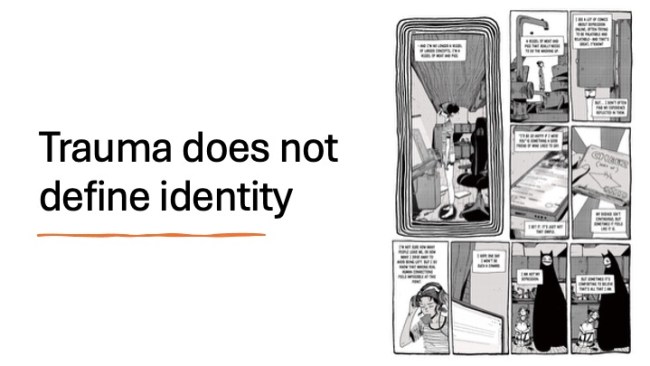
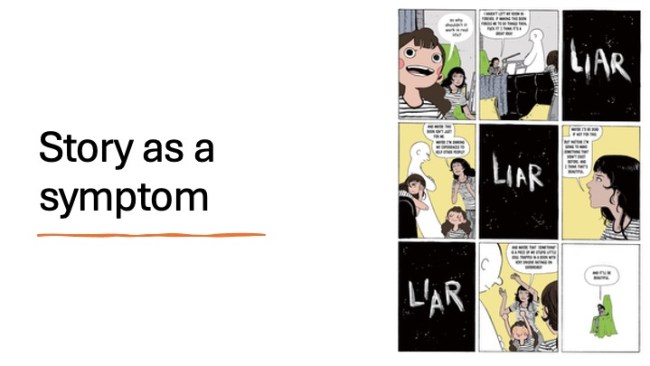
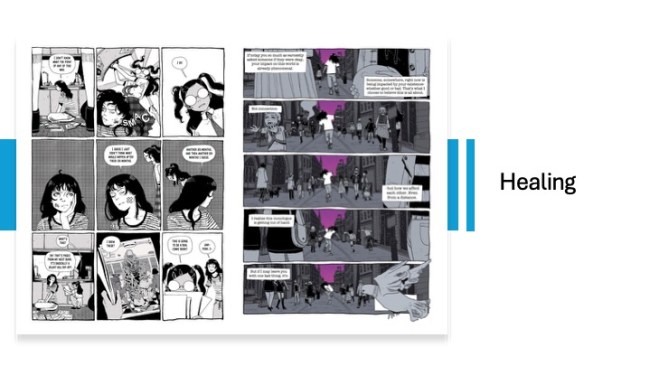
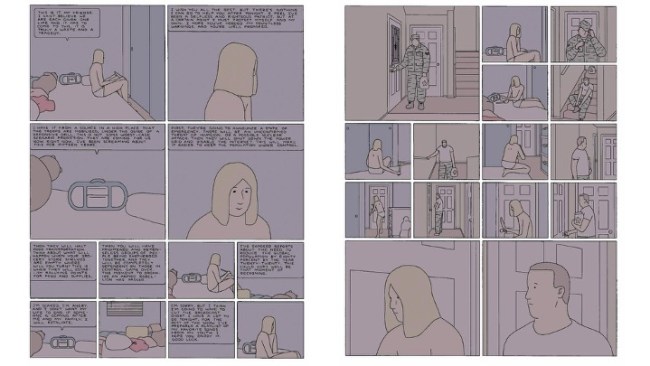
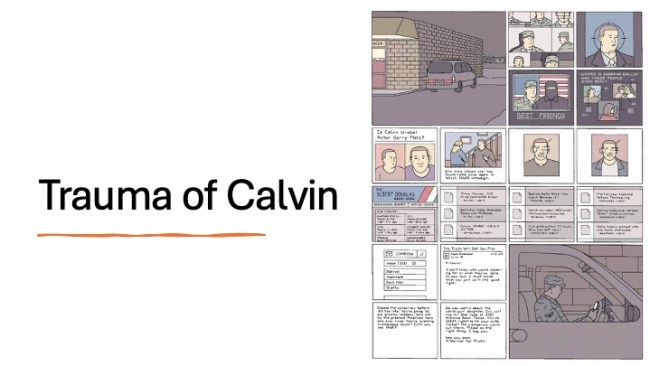
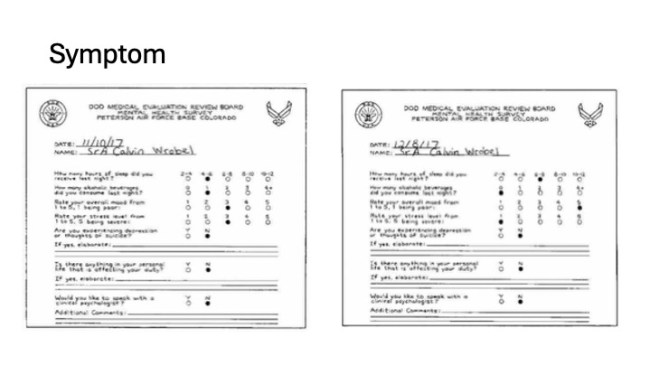
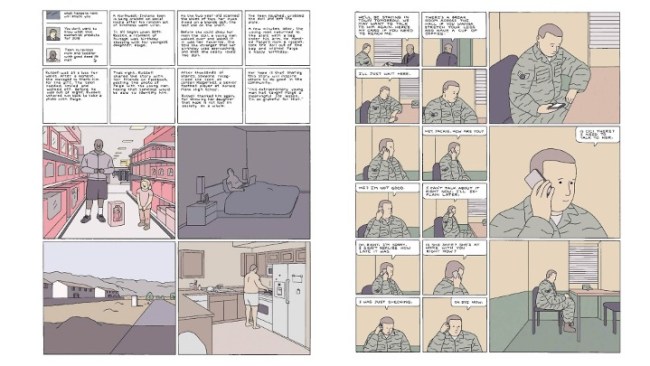
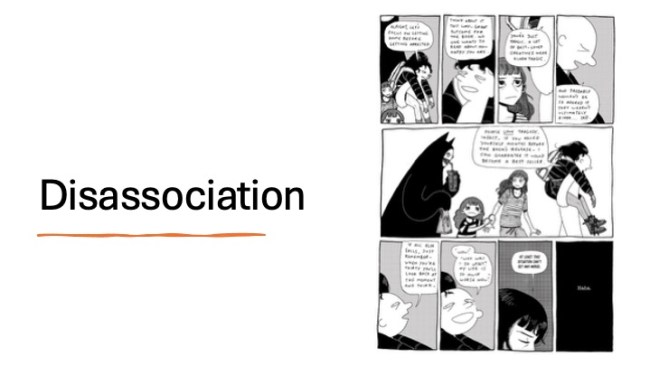
Before I made the presentation, I planned out 5 elements from each book I want to talk about. Then I found corresponding pages in the book and made the slide show. Then I wrote a rough script which has fewer academic sentences than the essay I typically write since it’s more important that the words are easy to follow, both for me and the audience. When I planned it out, I was not thinking about having a thesis that spans the entire presentation. Instead, I just picked a few interesting points in the book to discuss and relate to the Hillary Shute essay and the quotations. I think that not having a main argument allowed me to have more freedom to say the things I wanted to say, and it would be easier to follow the 20s pattern. I also decided to talk about the two texts separately instead of comparing them side by side because I knew I was not able to fit that much content into 20 seconds. Another reason is that one is an autobiography, and the other is fiction. I think the genre differs a bit too much for meaningful comparison in how they present trauma and healing. Thus, I talked about It’s Lonely at the Center of Earth in the first 5 slides and Sabrina in the last 5. For my visuals, I included minimal words and mostly pages from the book because I thought of them as evidence for the arguments I made. I tried to connect my spoken words to the slides, but there was simply not enough time for phrases like “look at the second panel where Calvin checks his phone, here he…” Prior to this experience, I was used to putting a few keywords on the slide show that help me remember what I am going to say, and maybe help a little with the audience’s understanding. However, due to the time constraint, I decided to use notecards that would ensure I don’t fumble, so I put fewer keywords on the slide show. However, in the end, I think I relied a little too much on the note cards due to nervousness, which means less interaction with the audience. I really admire the confidence of those who can just walk up there with nothing in their hands. I think Oliver did that. Next time, I would practice more so I can present without notes as well.

Assemblies

For this assignment, I reflected on what I learned throughout this semester and presented it in an order that is both chronological and reflective of how important each element is. When I thought I was finished, I found that I had not included the literacy narrative, so I added it in the blank space. I think my subjective interpretations of what I learned played a big role in how I created this diagram, and it might not accurately reflect what I actually gained from the course.

Sk10

For my playlist, I chose songs that are about the spirit of adventure and believing in oneself. It is a mix to help someone step out of their comfort zone and try new things. To achieve that, I incorporated optimistic and upbeat songs. There are a few songs about confidence, which is important for one to believe that they will succeed in uncharted areas. When I was building the playlist, I came across some songs that are encouraging and have romantic elements. I decided to leave them out because the theme of the playlist is self-oriented and does not have much to do with relationships. In the mix, I am arguing that one has to be confident and not be afraid to try new things in order to live with no regrets.
  1. Don’t Stop Me Now — Queen
  2. Adventure of a Lifetime — Coldplay
  3. The Nights — Avicii
  4. Try Everything — Shakira
  5. Brave — Sara Bareilles
  6. I Lived — OneRepublic
  7. On Top Of The World — Imagine Dragons
  8. Born To Be Wild — Steppenwolf
  9. Light It Up — Robin Hustin, Jex, TobiMorrow
  10. Hall of Fame (feat. will.i.am) — The Script, will.i.am
  11. Unwritten — Natasha Bedingfield
  12. Unstoppable — Sia

Movie Scene

Here's Johnny!': The Shining scene is scariest in movie history, claims  study | Horror films | The Guardian
I recreated the “Here’s Johnny!” scene in The Shining. The most challenging part was to get my facial expression right. I asked a friend to judge my expression and take the photo.

Literacy Narrative Part 3 Reflection

Click here to access the essay This project allowed me to express a similar idea in different mediums, specifically comic and alphabetical. I was able to experience the different constraints and possibilities that comes with the new medium. The comic was also a way for me to reflect on the strengths and weaknesses of my first draft. I was able to assimilate that experience and produce a better essay. When I looked over my original draft again, I found some flaws. The most important one is that the essay seemed out of focus and everything is not connected together by a main argument. When I made my literacy narrative into a comic, I realized that the continuous flow of thought is very important, even if its a essay instead of a story. A break in logic is more apparent visually than in words. In this newer draft, I treated it if as I am telling a story with a clear beginning, middle, and end. Before I was just kind of listing the experiences I had with writing, now I am able to tell it in a more logical order with a better understanding of the causations. For example, when I was writing part 3, I asked myself: “how did speed become so important in writing” and “why was it stressful”. With these in mind, I tried to establish clear connections between sections.

Self-track

For this assignment, I tracked 5 aspects of my personality as shown in the graph. I would like to know how does each aspect compare to another. In other words, I tracked my strength and weaknesses. I was not concerned with how each element changes with the days of a week so my visualization does not reflect the data of individual days but an average score through out a week. However, I only employed the data from Monday to Friday in the radar chart because during weekends my daily behavior changes drastically, resulting in inconsistent statistics if synthesized into the final score. The radar chart shows that my biggest weakness is discipline and my strong suit is optimism. I was aware of these before I did this assignment due to their obvious nature. For the other three elements, I was not so conscious of them but when I look at the graph and reflect the actions I measured for them to turn out this way on the graph, I finds that it does make some sense to me. While gathering my data, I decided to record the things I did each day that reflect on each of these categories. For example, for self-discipline, I recorded time I spent on entertainment and how many work I procrastinated and other things. For optimism and empathy, I employed a mix of both subjective and objective variables. To develop a comparable score for each one, I standardized my data and roughly calculated a sum. If I were to do this in the future, I would have focus on just one category at a time and record more detailed objective variables. I think it could be a good tool for self analysis if sufficient data is recorded to provide a reliable and comprehensive conclusion.

Literacy Narrative Part 2 reflection

Click here to access the comic. Writing my literacy narrative as a comic, while allowing me to communicate my story in a different medium, comes with different constraints and opportunities. Compared to my written draft in part 1, I focused exclusively on the main argument, which is that the way I have been taught to write has shaped my relationship with writing, in the comic. The comic is concise and clearer. I realized that in comics, maybe due to their visual nature, it would be a lot more obvious if the argument is sparse and jumping here and there. If I drew my panels according to the exact sentences in my literacy narrative part 1, the comic would be confusing and hard to follow. On the other hand, in comics, I get to express how I feel visually. For example, I drew a lot of clocks, literally pushing the character down, to show the pressure from time constraints. Creating the comic also made me realize the different stuff the cartoonist has to think about, such as directing the reader’s attention to the right place, which writers don’t have to worry about since no one starts reading at the center of a page. In comics, unlike essays, you have to plan ahead before you put pen to paper because you have to consider the all-at-oneness. Or else the panels will not be able to interact with each other and make a page the smallest unit of the comic. Therefore, when I was creating the comic, I was engaging in a sort of bottom-up way of thinking where I developed a conclusion first and then decided how to lead the reader there with panels. In the literacy narrative part 1, I started writing first and waited to see where it would take me. I think the individual conference helped me a lot in developing an argument in a reflective text.  For the beginning of my comic, I tried to imitate the opening of Stitches, creating a sort of zooming effect. After I drew it, I realized that the first 4 panels of my comic would work better if they were all at the same angle, whether tilted or looking straight down. I decided to hand-draw my comic to give it a more personal touch than computer-generated drawings since the topic is about myself. In terms of material, I chose a pen over a pencil because the scanning of pencil tracings did not work that well in the tracing pages assignment. If I had watercolor, I would add color to my comic to help create different moods. In my comic, I put the most important scene in the biggest panel to lead the reader there. On the third page, I tried to play with interactions between panels by drawing the clock pushing the character down into the spiral. I think it worked out quite nicely, but if I had more time, I would make more deliberate choices in the last two panels. I feel like they are kind of disconnected from the upper part of the page.

Headphone

I developed the idea and planned out the panels first before I started drawing. This time the idea of an ignorant person getting saved came to pretty fast. I think I could have drawn the car better but it does the job. It’s pretty similar to triptych where I had to tell a clear story with confined space but one more panel make it a bit more flexible. There could be more action in the middle. I created this because it is humorous but also carries a message.

Tracing Pages Reflection

Thesis: Both comics express emotions through assigning value to inanimate objects and nonlinear sequencing of the panels, but they have different underlying conflicts; therefore, Walden focuses on her own perspective, while Small attempts to explain the actions of others as well as his own. The essay argues that the different central conflicts of the two comics caused the different emphasis of perspective. It was a bit difficult tracing the pages because both comics employs a lot of shadows and bright/dark contrasts. I did not capture a lot of that kind of details in my trace. Also the scanning did not work too well either. Therefore in my essay I used images from the original illustrations instead of my trace. Before the annotation, I read Making Comics again and I was able to keep the elements in mind while I annotated. For instance, I was taking notes of the angle of the shot. Usually I write my thesis before I start the essay but this time I wrote the first two paragraphs first and then formed a thesis. I think this caused my essay’s emphasis to be a bit side-tracked. I should have spent more ink in the last paragraph and focus less on the first two. On the other hand, if I had developed a thesis at the beginning, it might not be as insightful as the one I have now. I feel this assignment has made me more aware of the choice that the cartoonists are making. I think the biggest insight I gained is realizing that for the protagonist of these autobiographical comics, understanding and expression might be a part of their defense mechanism of childhood trauma. We have to consider how their experience influence their way of storytelling.

Backpack Contents

Content:
Macbook Pro 2020
Notebook
Pen
Mechanical pencil * 2
Mechanical pencil lead
Eraser
Pencil bag
7 Dollar worth of change Great for school and for mom to think I am behaving. I did not try to create a certain persona. I took what’s in my bag and laid them out on the table. The collection represents a student and that is who I am most of the time. The contents are the bare minimum I need to go to classes. I try to carry as little as possible when I go out to make my life easier. I also usually don’t plan ahead so there will not be an umbrella in my backpack. I think this representation is similar to writing in the way that you have to consider what’s there and what’s not there. Additions and Omissions both tell a story.

Posts navigation

1 2
Scroll to top