My chart (from Google Sheets) measures how many hours of sleep I get, the quality of the sleep, and how productive I am the next day as a result.
When I saw this assignment, my first thought was how I could measure my productivity and the main factors that contribute to that. I ended up landing on how many hours of sleep I get and the quality of the sleep I get as the main factors towards my productivity. I wrote down in my notes app exactly what time I put my phone away for bed and exactly what time I picked it up in the morning. I rounded to the nearest hour and input that into my Google Sheet. I measured sleep quality by many criteria. I measured it by if I had dreams or not, how I felt in the morning, and how easy it was to wake up. The combination of those led me to choose the numbers that I did. Finally, I measured productivity by the amount of work I was able to get done and how attentive I was able to be during my classes.
One thing I realized is that sleep quality is probably the most important thing to stay on top of. If I sleep for 8 hours but have low sleep quality, such as a score of 4, I will not be productive the next day. This concept interested me because I originally thought that I would be most affected by how many hours of sleep I got instead of the sleep quality. After this realization, I started researching ways to improve my sleep quality so that I could be more productive in the upcoming day. I found that creating a consistent schedule, making your environment fit your needs, and eating more fruits and vegetables can improve your sleep quality, so that is what I will try to do in the upcoming months.
#sk8
I wanted to make something simple and relatable for this four-panel comic, so I focused on the idea of trying to get things done but ending up doing the opposite. In the first panel, I had a clear goal. In the two middle panels, I showed how that goal slowly fell apart because I was overplanning and getting distracted. The story felt more real with two middle panels because the problem doesn’t happen all at once; it builds over time. One problem was making sure the second and third panels didn’t feel like they were repeating themselves, since they are both part of the buildup. This format gave me more room to stretch out the middle of the story instead of rushing to the end, which was better than the triptych. I had to think more about the pacing and how each panel moved the joke along, even if it was just a little bit. I picked this story because it’s something that many students and I deal with all the time. In general, making this comic taught me that even a short strip can tell a whole story if each panel has a clear purpose.
#sk7
I think the revised version is better than the original because I refined my thesis and turned it into a stronger and more coherent argument. I reconsidered the points I made in the earlier paragraphs and re-evaluated my understanding of the ABT structure. By shifting the emphasis of the thesis toward how the authors retrace their memories of past life events—including their trauma—I realized that this process of revisiting the past plays an important role in healing. This revision also gave me more perspective when reflecting on what “retracing” means, especially in relation to Hillary Chute’s Graphic Women. I believe the previous version lacked a clear thesis structure because I was not fully aware that the thesis should come after the “T” in the ABT framework. In contrast, the thesis in this version makes the essay stronger by clearly tying together the use of text, the use of color, and the strange, non-linear nature of time in comics.
For this sketch assignment, I used a cell model as my assemblies to represent what I’ve done throughout this course. Each part of the cell represents something I’ve accomplished over the three months I’ve been in this course, including different assignments and writing skills I’ve learned.
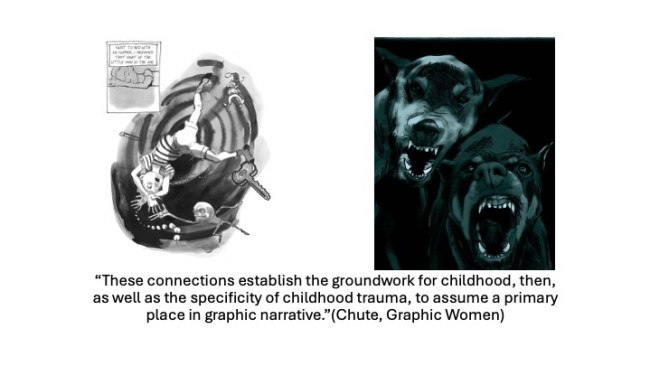
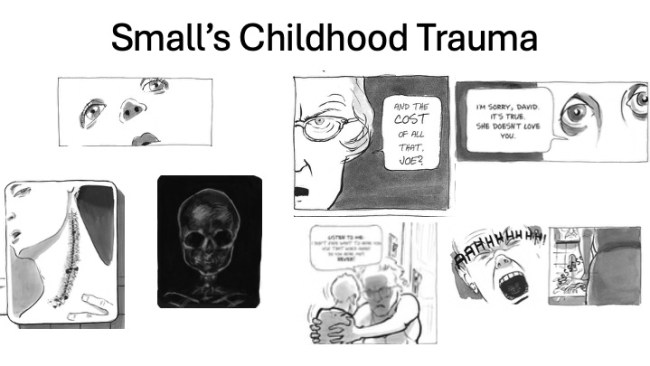
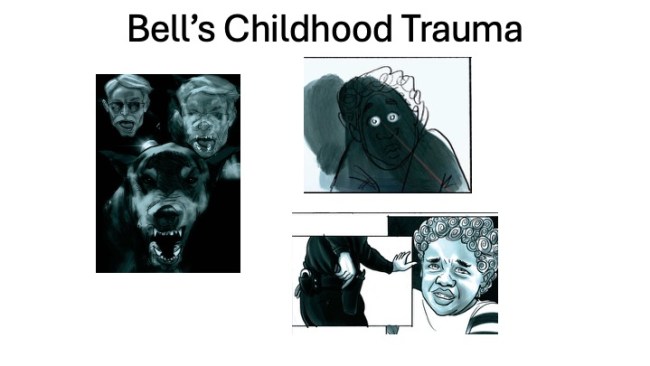
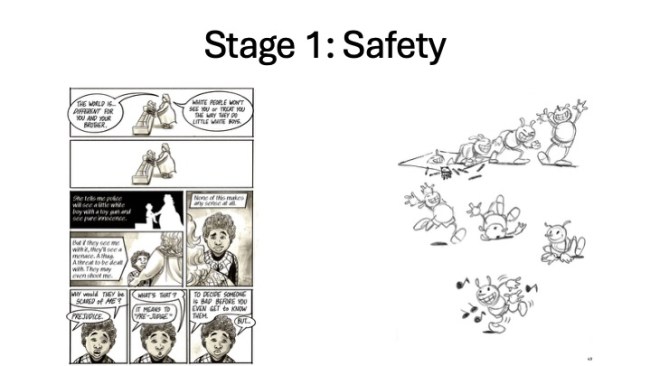
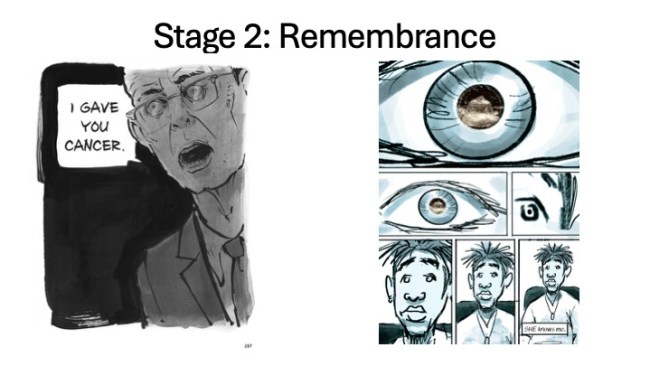
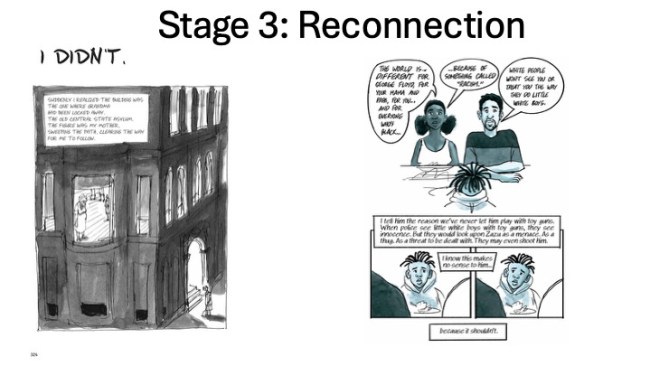
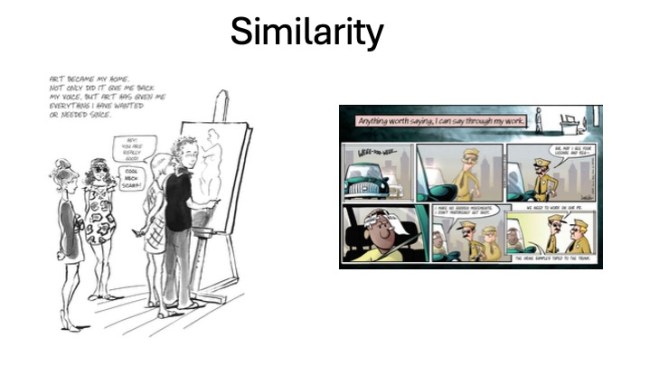
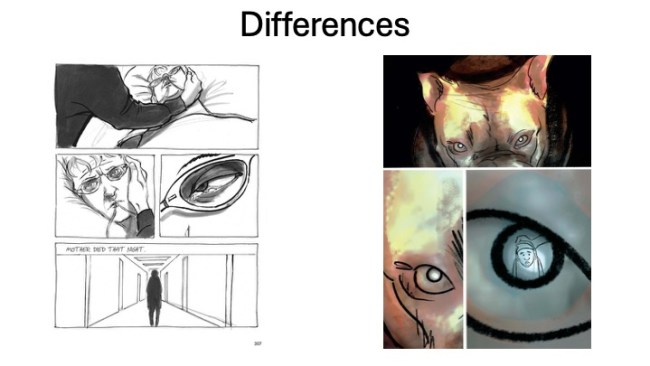
When I first started the Halfa Kucha assignment, I felt it was really hard to fit all my arguments into a 3-minute-and-20-second presentation. I began by writing my topic in a Word document, focusing on childhood trauma in The Talk and Stitches. I then crafted my main arguments and tried to support my thesis with evidence. However, I realized it was extremely difficult for me to cut content because I felt that if I didn’t include every point from my draft, my argument wouldn’t make sense. In the end, I did it—I removed the parts that I thought wouldn’t affect the overall presentation. To help my audience follow my argument more clearly, I often compared the two comics side by side by placing one image from each comic on the same slide to represent the evidence for my claims. Visually, this allowed my audience to see the comparison directly. What I learned from this presentation is that a script isn’t necessary if I truly understand what I’m going to say. In high school, I often relied on scripts and note cards, but with strict time limits for each slide, it’s better to let go of the script so you can present more naturally and confidently. I also realized that many of my classmates noticed strong arguments that I missed during my first reading, which makes me want to read graphic memoirs and novels more carefully in the future.
Both Tillie Walden in Spinning and David Small in Stitches use space, lighting, and repetition to show how teenagers deal with trauma, loneliness, and self-expression. Silence is often used in graphic memoirs to exemplify emotional depth. Small’s scene in the dark auditorium on page 215 also uses shadows, a small figure, and repeated film frames to depict a peaceful haven created out of silence. Walden’s scene on page 169, where Tillie says, “I feel like I swallowed my own voice,” uses minimal panels and soft blues to make her emotional confusion visible.
However, Spinning’s silence serves a different purpose than Stitches’ silence. The reader is forced to concentrate on Tillie’s body language and the muted surroundings in Spinning because of the pattern created by repetition and empty space, which represents her internal conflicts. In keeping with Hillary Chute’s theory that comics “represent the unspeakable…by making space for absence,” her “swallowed voice” is expressed through absence. However, in Stitches, silence is no longer forced but rather chosen. Small depicts David by himself in the auditorium, where darkness serves as solace rather than loneliness, using panel layout and lighting. Because he chooses to be alone, away from the cacophony of his house, the steady panels and slowed pacing feel soothing rather than oppressive.
As a result, the two memoirs present different interpretations of silence. Stitches presents silence as an escape that provides clarity and protection, while Spinning portrays silence as involuntary, shaped by trauma and emotional repression. Consequently, by contrasting these two uses of silence, it is clear that silence in comics can convey both solace and vulnerability, and that the visual techniques of light, space, and repetition turn “quiet” into a strong force in both texts.